
Frequently Asked Questions about Soil Restoration
Find quick and detailed answers to the most common questions about our surface restoration, polishing and crystallizing services.
Basic ConceptsBasic Concepts
1. What exactly is soil crystallization?
Crystallization is a chemical and mechanical process that uses a special liquid (usually magnesium fluorosilicate) that reacts with the calcium carbonate present in the stone. Through the friction and heat of a steel wool machine, a very hard, transparent and shiny layer of crystals which is integrated into the material itself, protecting it from wear.
2. What is the difference between polishing, diamondizing and crystallizing?
He polished Use abrasives to remove the damaged surface layer, removing scratches and stains. He diamond is a more advanced polishing that uses diamond-dusted discs for deep grinding, leveling the floor and removing stubborn marks. For its part, the crystallization It is the final chemical process that is applied to the already smooth floor to harden it and give it a mirror-like shine.
3. In what types of soils can crystallization be carried out?
Crystallization is effective on surfaces of natural stone containing calcium carbonate, mainly the marble, terrazzo, limestone and some types of granite or polished concrete.
4. Can I crystallize a ceramic, stoneware or wooden floor?
No. Ceramic and stoneware do not contain calcium carbonate, so the crystallizing liquid would not produce any chemical reaction. It also cannot be used on wood, laminate or vinyl floors, as the products and machinery would damage these materials.
Preparation and Process
5. Is it mandatory to clean the floor before polishing or crystallizing?
Yes, it is a non-negotiable step. If you try to polish or shine on a surface with dust, grease or residue from previous products, the dirt will be sealed under the shine, the product will not adhere properly and the particles could scratch the stone.
6. What is the difference between using a fiber disc and a steel wool disc?
He steel wool disc It is used for the chemical crystallization process, since the friction of the metal generates the exact heat necessary for the product to react and harden the stone. He fiber disc (or pad) is used for deep cleaning, light stripping or for surface polishing without the risk of leaving metal chips.
7. Do I need to empty the room before they do the work?
Ideally, the area should be as clear as possible. If there is heavy furniture that cannot be moved, it is necessary to protect its bases very well with tape or plastic, since the crystallizing liquid could splash and irreversibly stain the wood or metal.
8. How do you avoid "spots" or opaque areas when applying the crystallizer?
These marks usually appear if too much product is applied or if the rotary machine is run too quickly. Professionals use the technique of "Double Cross Pass" (vertical movements followed by horizontal movements) to ensure that the heat unifies the shine without leaving bursts or shadows.
9. Will the floor be slippery after polishing or crystallized?
A professional crystallization with high-end products does not produce a sliding effect. Although the finish looks like a "wet mirror", the hardening process increases grip, making the surface safe to walk on.
Maintenance and Care
10. How often should a marble or terrazzo floor be crystallized?
For a private home with normal traffic, it is usually sufficient to carry out a complete crystallization every 1 to 4 years. In commercial or high traffic areas, more frequent maintenance may be required.
11. What is the best way to clean my floor on a daily basis so that the shine lasts?
The best routine is to remove daily dust with a dry mop or vacuum cleaner, since the grit acts like sandpaper. To scrub, use only water and a neutral pH soap specific for marble or terrazzo, and make sure to dry well to avoid water marks.
12. What cleaning products are prohibited on marble and terrazzo?
They should be completely avoided acids (lemon, vinegar), bleach, ammonia, and harsh degreasing cleaners. These products act as corrosives, weaken the seal and "eat away" the shine, leaving irreversible dull stains.
13. What do I do if lemon juice or wine is spilled on my marble floor?
You must absorb liquid immediately without rubbing, so as not to spread the acid. Next, clean the area with plenty of water and neutral soap, and dry it perfectly with a soft cloth.
14. Is it important to seal the marble floor after polishing it?
Yeah. Marble is a porous stone that absorbs liquids easily. Applying a sealer after polishing creates a critical protective barrier against moisture, daily wear and tear, and organic stains.
Specific Cases and Hydraulic Soils
15. Is it worth polishing a very old and damaged terrazzo floor?
Definitely yes. Polishing old terrazzo eliminates worn surface layers, erases deep scratches and stains, and by recovering its shine, completely revalues the space without having to resort to expensive replacement works.
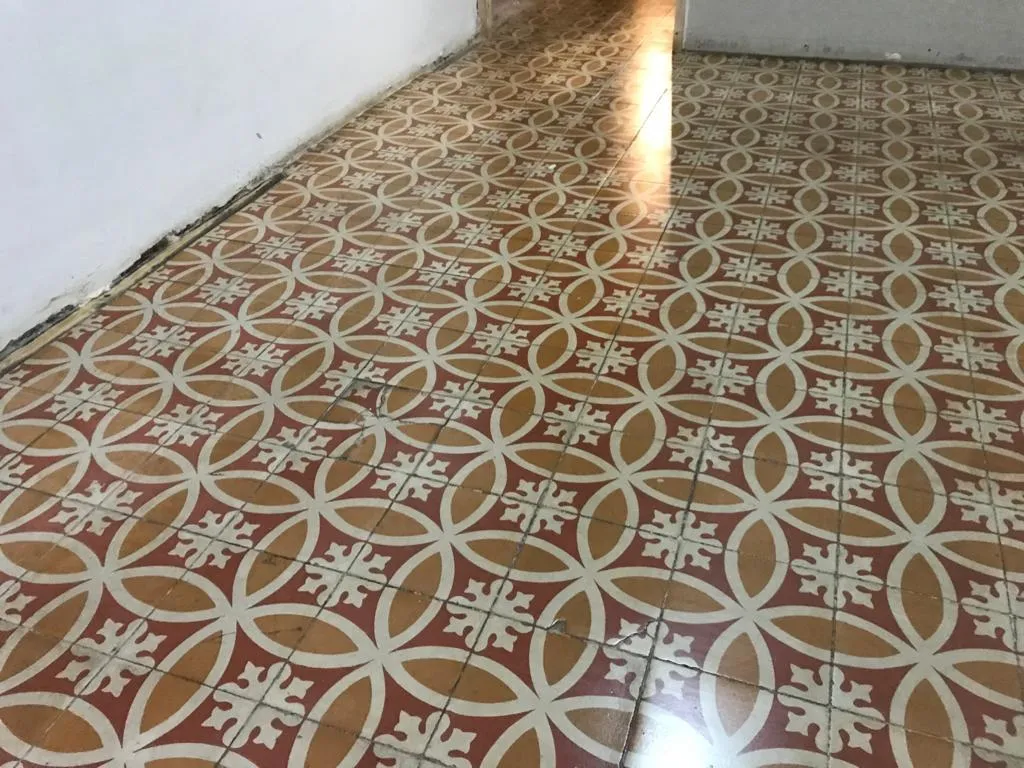
16. Can an old hydraulic mosaic floor be aggressively polished?
Very careful techniques must be used for antique hydraulic mosaic, since the top layer containing the pigment and design is only a few millimeters thick. A treatment of deep chemical cleaning (stripping) and micro-polishing with very thin discs so as not to irreversibly wear out the original part.
17. How do you recover the dull color of hydraulic tiles?
After a thorough degreasing cleaning, a protector or sealant with "wet effect". This product penetrates the porosity of the mosaic, intensifying the tone of the mineral pigments and restoring its original vibrancy, after which it is sealed with liquid wax.
18. How do I maintain the shine on a terrazzo floor without professional machinery?
For home maintenance, you can periodically add a little liquid terrazzo wax or a floor scrubber with polish to the mop bucket. Little by little the floor will acquire a protective shine, although it will not be as intense or durable as a mechanical crystallization.
Common Errors
19. What happens if I apply too much liquid polish to the floor?
Believing that "more is better" is a serious mistake. Excessive polish or wax leaves the floor with a sticky, uneven finish and prone to collecting dirt, which in the long run will darken and opaque the pavement. A thin, uniform layer should always be applied.
20. My newly crystallized floor lost its shine very quickly, why did this happen?
It generally occurs for three reasons: a "Base Crystallizer" was not applied to seal the pore before finishing, the floor was not cleaned properly before treatment, or cleaning products that are too acidic or alkaline are being used in daily maintenance.
21. What happens if I don't let the polishing product dry before stepping on it?
If you walk on the floor or allow passage before the polish or crystallizer has completely cured, you will leave permanently marked footprints and you will ruin the smooth finish of that area.
22. Why is it a mistake to use sponges or hard scouring pads to clean stains on marble?
Metallic or abrasive scouring pads (like typical green kitchen scouring pads) scratch the micro-polishing that was achieved with the machinery. These micro-scratches kill the shine instantly and make the stone look dull. Soft cloths or microfiber mops should always be used.
Do you have any other questions?
Contact our team of professionals and we will advise you without obligation on the best solution for your floor.
Write to us on WhatsApp